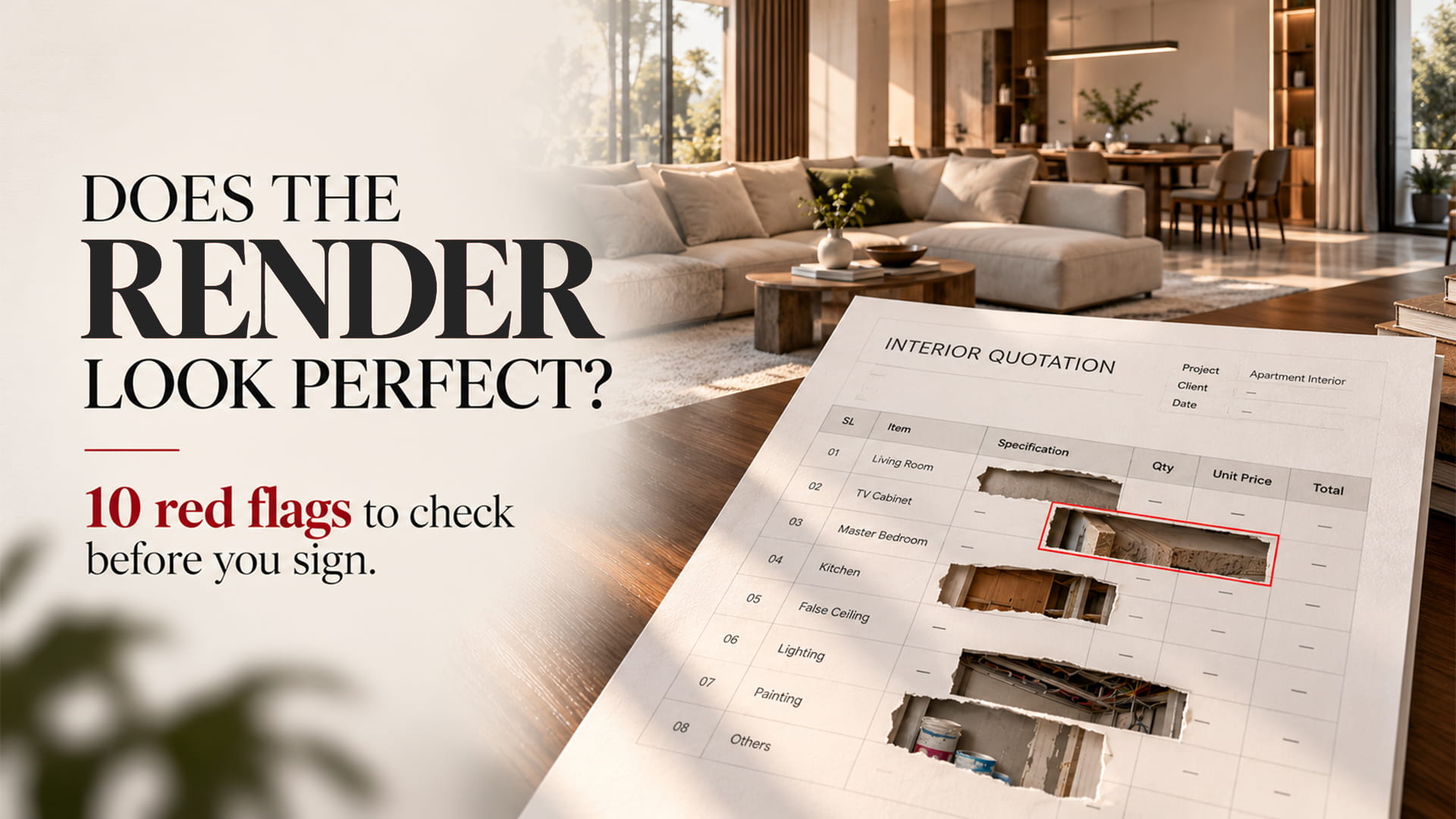
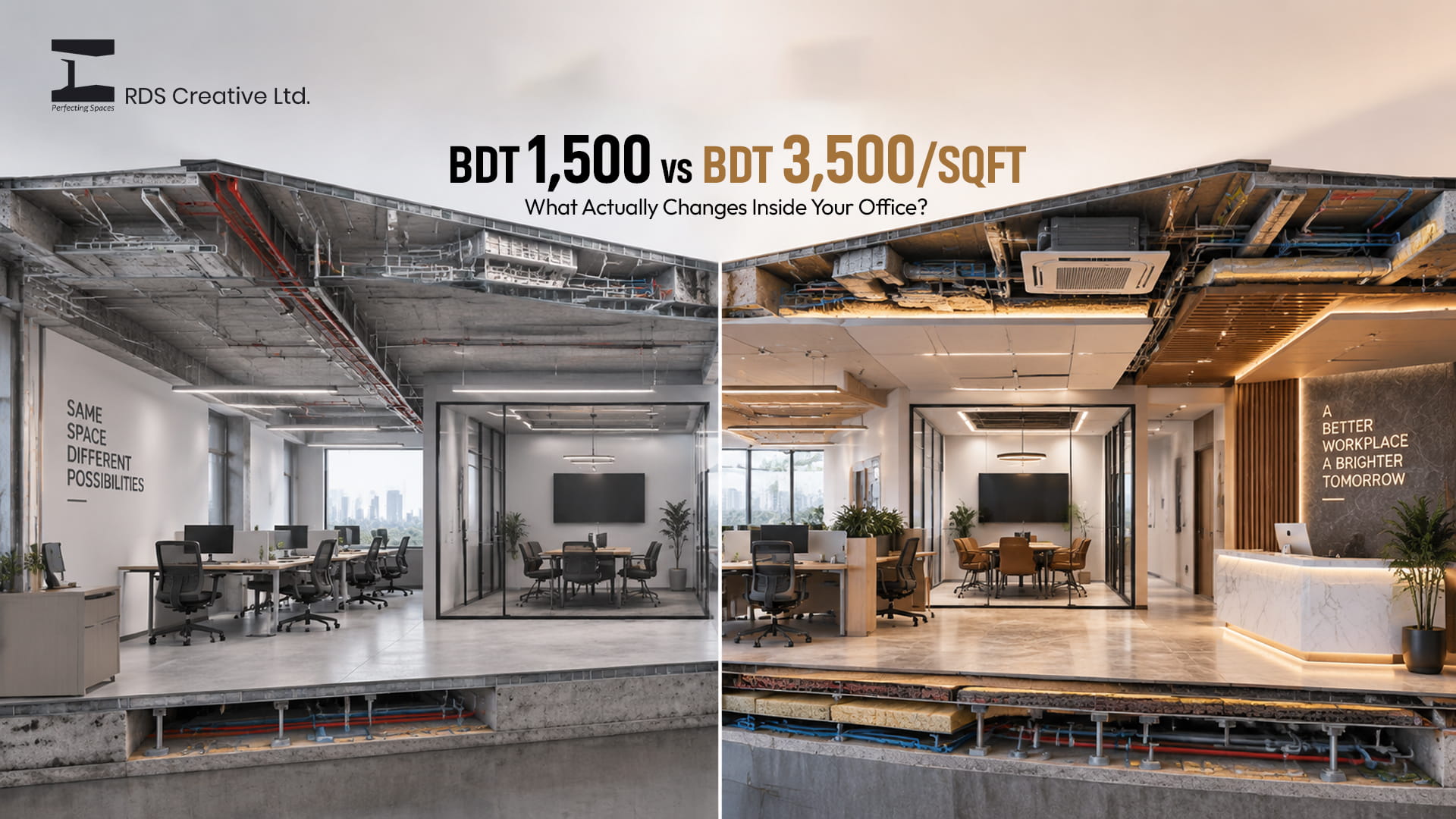
A quotation is the first real document a design firm hands you, and it tells you far more than the 3D renders do. Renders show what a firm hopes to deliver. The quotation shows how the firm actually works: how it defines scope, how it names materials, how it treats changes, and how openly it deals with money.
We review quotations from other firms regularly, usually when a homeowner or business owner wants a second opinion before signing. The same warning signs appear again and again. None of them prove a firm is dishonest, but each one is a reason to slow down and ask questions before any advance payment moves.
This guide walks through the ten red flags we see most often, why each one matters, and what a clear quotation looks like in its place.
The 10 Red Flags at a Glance
| # | Red Flag | What a Healthy Quotation Shows Instead |
| 1 | A single lump-sum total | Itemized lines by category and unit |
| 2 | Vague material descriptions | Named brands, grades, and finishes |
| 3 | No quantities or units | Measured quantities for your actual space |
| 4 | Exclusions buried or missing | A clear “not included” list |
| 5 | No contingency stated | A visible, defined contingency line |
| 6 | Undefined change-order process | Written variation procedure |
| 7 | Payment demanded mostly upfront | Milestone-linked payment stages |
| 8 | No timeline or milestones | Dated phases with handover terms |
| 9 | No warranty or defect terms | Written post-handover support terms |
| 10 | Pressure to sign quickly | Reasonable validity period and time to review |
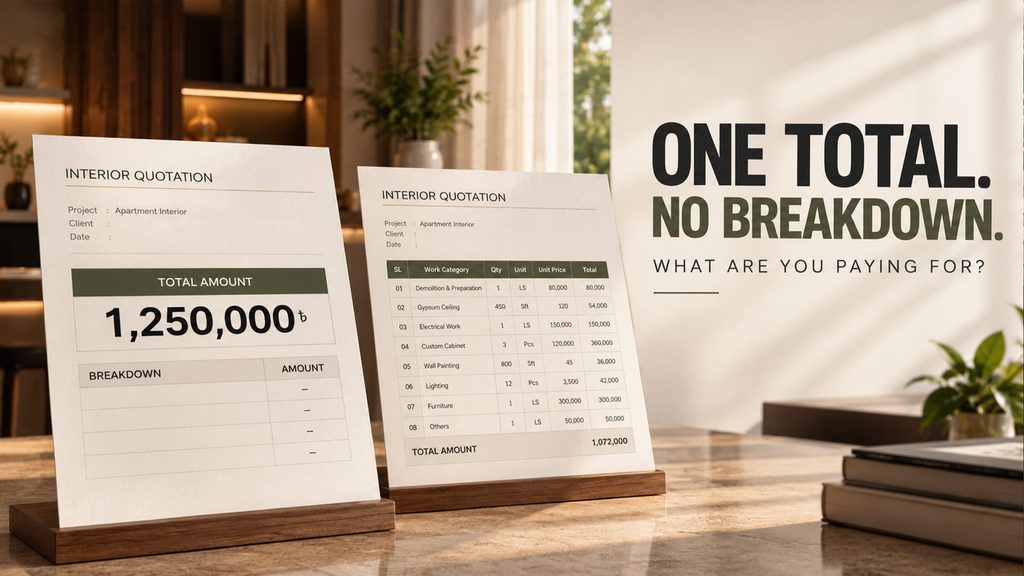
Red Flag 1: A Single Lump-Sum Total
If the document ends in one number with nothing behind it, you cannot tell what you are paying for, and you cannot compare it with any other offer.
What we do instead: every quotation we issue is built from an itemized bill of quantities, with each category and line shown separately. The RICS New Rules of Measurement (NRM2) is the internationally referenced standard for how that kind of itemization is structured.
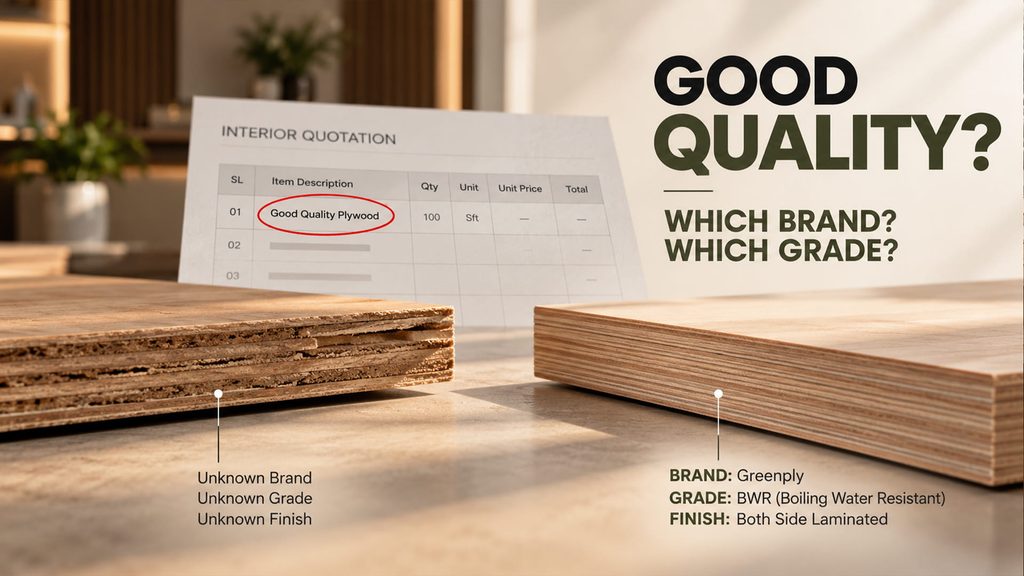
Red Flag 2: Vague Material Descriptions
Phrases like “good quality plywood,” “premium laminate,” or “branded hardware” leave room for substitution later. In Dhaka’s humid climate, the difference between marine-grade and standard board shows up within a monsoon or two.
What to look for: specific brand names, board grades, laminate series, and hardware makes written against each line.
Red Flag 3: No Quantities or Units
A line that says “wardrobe” with no dimensions, or “false ceiling” with no area, cannot be checked against what is eventually built.
What to look for: every line should carry a unit (square feet, running feet, per piece) and a measured quantity taken from your own floor plan, not a generic estimate.
Red Flag 4: Exclusions Buried or Missing
Many disputes begin with an assumption. The client assumes civil work, delivery, or installation is included; the firm assumes it is not. If the quotation never says, both sides are guessing.
What to look for: a plain list of what is not included, such as civil work, appliances, permits, or specialist MEP, so nothing surprises you at the final invoice. We cover how these gaps grow in our guide to hidden costs in Dhaka interior quotations.
Red Flag 5: No Contingency Stated
Every project meets some unplanned issue, whether a site condition behind a wall or a material shortage. A quotation with no contingency line treats every surprise as a new charge.
What to look for: a defined contingency allowance shown openly, with a note on how it is used and reported.
Red Flag 6: No Process for Changes
Design changes are normal. What matters is how they are priced and approved. If the quotation is silent on this, changes tend to be agreed verbally and billed later.
What to look for: a short clause stating that changes are written down, priced, and approved by you before work proceeds.
Red Flag 7: Most of the Payment Demanded Upfront
A large advance before any visible work leaves you with little leverage if the project stalls.
What to look for: a payment schedule tied to milestones, such as completion of civil work, delivery of furniture, and final handover, with the last stage released only after your sign-off.
Red Flag 8: No Timeline or Milestones
“Around two months” is not a schedule. Without dated phases, there is nothing to measure delays against.
What to look for: a phased timeline with start, key milestones, and a handover date, plus a stated position on delays. This is also where dedicated interior project management earns its place, because someone is accountable for the dates.
Red Flag 9: No Warranty or Defect Terms
If the quotation says nothing about what happens after handover, assume nothing is promised.
What to look for: a written defect-correction period and warranty terms for workmanship and fittings, so post-handover problems have a clear route to a fix.
Red Flag 10: Pressure to Sign Quickly
“This rate is only valid today” is a sales tactic, not a pricing reality. A confident firm gives you time to review, compare, and ask questions.
What to look for: a reasonable validity period written on the quotation, and a willingness to walk you through any line you do not understand.
A Quick Scorecard: How Does Your Quotation Measure Up?
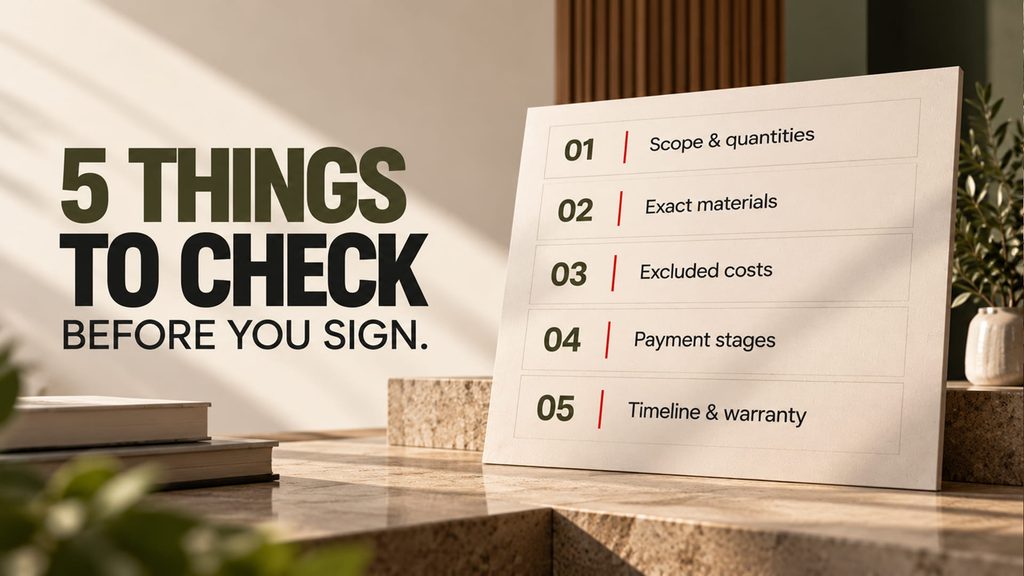
Check each item that your current quotation clearly includes:
- Itemized lines with units and quantities
- Named brands and material grades
- A written list of exclusions
- A visible contingency allowance
- A written change-order process
- Milestone-linked payments
- A dated timeline with a handover date
- Written warranty and defect terms
- A reasonable validity period
If several boxes are empty, send the quotation back and ask for a revised version before you pay anything. If the firm resists, that response is useful information in itself.
Frequently Asked Questions
Is a single red flag enough to walk away? Not always. A missing warranty clause or an unclear timeline can often be fixed with a revised quotation. Several red flags together, or a firm that will not correct them, are a stronger reason to look elsewhere.
Can I ask another firm to review a quotation I already received? Yes. A second opinion on scope, specification, and payment terms is routine and worth doing before signing.
What if the firm refuses to itemize? Treat that as a serious warning. Without itemization, you cannot verify scope or compare offers.
Where can I go if a dispute arises over services I paid for? Bangladesh has a statutory consumer protection framework. The Directorate of National Consumer Rights Protection (DNCRP) handles consumer complaints over goods and services, and a written quotation and contract make any complaint far easier to support.
Read the Quotation Before You Trust the Renders
A good quotation is specific, itemized, and open about its limits. It protects both sides by making expectations visible before money moves. Every red flag above is simply a place where something important was left unsaid.
Holding a quotation you are not sure about? Contact RDS Interior for a second-opinion review, or request an itemized quotation built line by line around your space.
Related Posts